
Examples in Multisector / Master Plans for Aging and Older Americans Act State Plans
Gretchen Alkema, Wolf Eagle Enterprises, LLC | October 2026
Executive Summary
As our nation grows older and focuses more on healthy aging, state and local leaders are innovating through strategic efforts such as multisector / master plans for aging (MPA), Older Americans Act (OAA) state plan renewals, governor- and mayor-led initiatives, and the like. These efforts are setting priorities right now that will frame success for the healthy aging ecosystem in the next decade.
Now is a perfect moment to memorialize the power of creative aging in the healthy aging ecosystem by naming it directly in federal, state, and local policy plans. Several states have already taken the lead. As such, Lifetime Arts developed a searchable database of the exact language used in state healthy aging plans that is aligned with creative aging. Its purpose is to elevate awareness of creative aging in existing policy plans and serve as a starting point for others seeking to incorporate similar language into cross-sector planning at the federal, state, and local levels.
Creative Aging on the Rise
Creative engagement through the arts is fundamental to the human experience and deeply linked to enhanced health and well-being, particularly for older adults. Drawing on a wealth of health promotion research, creative aging is the practice of intentional artistic and creative engagement throughout our lives, advancing vital ways to help restore and maximize health and functional ability regardless of one’s age, health status, or perceived capabilities. Successes are linked to three key topics in today’s healthy aging agenda: brain health, social connectedness, and livable communities.
As a growing field, creative aging efforts are flourishing in intergenerational programs, senior/community centers, museums, libraries, independent and assisted living residences, and universities to name a few. Across urban and rural landscapes, creative aging coalitions have formed, informational hubs connect older adults with local arts programs, and state agencies dedicate staff and funding to help innovative programs take hold.
Preparing for an Aging America
As creative aging continues to expand, the well-documented growth of America’s older adult population is in full bloom. Far from a homogeneous group, older adults range from age 65 to almost 115 years old, come from a wide range of backgrounds, experiences, and preferences, and regularly dismantle stereotypes about what it means to be “old.” This demographic change has empowered public- and private-sector leaders as well as consumer voices to reimagine care and services in the healthy aging ecosystem that better support older adults and their caregivers.
State and local level transformation is happening through long-standing planning efforts, such as renewals of Older Americans Act (OAA) state plans that are required to receive federal funding. Similarly, many states and localities are spearheading innovative efforts by developing multisector / master plans for aging (MPA), governor- and mayor-led healthy community initiatives, and the like.
Using these policy vehicles, state and local leaders are setting priorities, goals, and initiatives right now that will advance the framework for healthy aging over the next decade. This is a perfect moment to memorialize the power of creative aging in the healthy aging ecosystem by naming it directly in federal, state, and local policy plans and linking its success to improvements in brain health, social connectedness, and livable communities.
State Planning Efforts That Include Creative Engagement
Lifetime Arts reviewed the current MPAs and OAA state plans as of June 2026. Over half of states and the District of Columbia have named arts, music, culture, and/or creative aging in these formative strategic planning documents. Many include arts-based programmatic examples that address dementia care, social isolation, caregiver strain, lifelong learning, community cohesion, and multicultural belonging.
The map below identifies states that currently embrace creative engagement, and creative aging specifically, in their OAA state plans and MPAs. While most of the action exists within OAA state plans, MPAs in seven states include language on creative engagement:
- Illinois, Massachusetts, Minnesota, and Oklahoma MPAs include arts, music, and/or culture-based language.
- Pennsylvania, Utah, and Vermont MPAs specifically include the concept of “creative aging.”
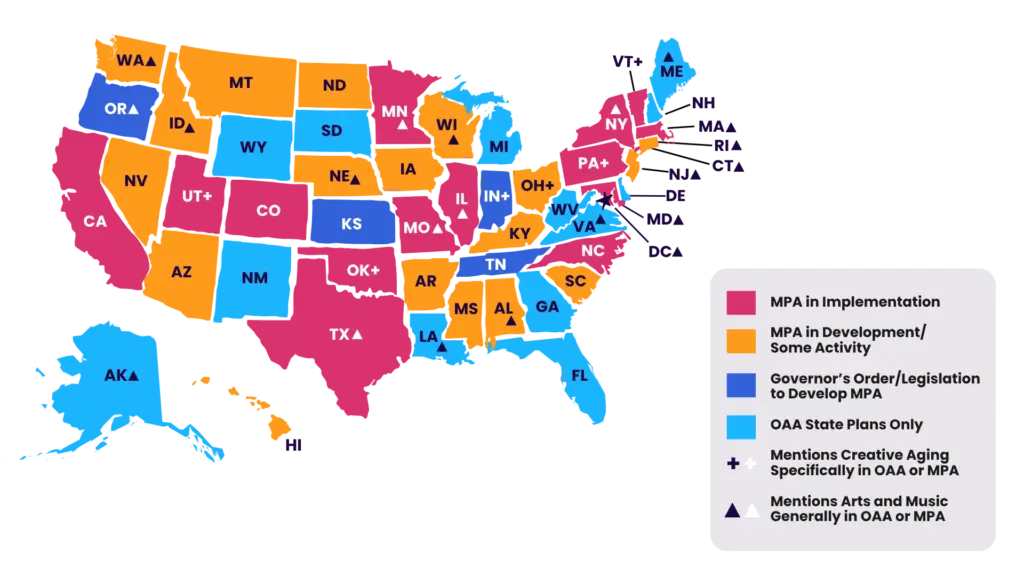
Building on this analysis, Lifetime Arts developed a database of the exact language used in state plans that relates to creative engagement, including creative aging. This database seeks to elevate awareness of creative aging principles in healthy aging policy plans as well as help others incorporate similar language into future cross-sector planning efforts at the federal, state, and local levels.
The database linked here is searchable by state, health aging plan type, and keywords. As a living repository of state policy plans that amplify creative aging, it will be updated regularly as new examples are identified.
For a deeper look at creative aging and its role in the healthy aging ecosystem, please see our recent policy brief.
To learn more about multisector / master plans for aging and how to get started, please visit the Multisector Plan for Aging Toolkit from the Center for Health Care Strategies.
ABOUT THE AUTHOR
Gretchen Alkema is president of Wolf Eagle Enterprises, a strategic engagement firm that delivers clear-eyed insights and resource-conscious solutions to health, aging, and care delivery industries. Learn more at WolfEagleEnterprises.com.
ABOUT LIFETIME ARTS
Lifetime Arts is a nationally recognized nonprofit transforming the way our society understands and experiences aging through the arts. Since 2008, we have been at the forefront of the creative aging movement—an evidence-based practice that combines arts participation with social engagement to foster healthy aging. Together with our partners, we are working to combat isolation, challenge ageism, and celebrate lifelong creativity. By bridging vision and action, we embed creative aging practices into public health, cultural policy, and aging services—ensuring that creativity is recognized as essential to well-being at every stage of life. Learn more at LifetimeArts.org.
ACKNOWLEDGEMENTS
This report was generously supported by The Music Man Foundation.