Advancing Brain Health, Social Connectedness, and Livable Communities
Gretchen Alkema | February 2026
Executive Summary
Creative engagement through the arts is fundamental to the human experience and deeply linked to enhanced health and well-being. Specifically older adults serve as unique and essential cultural contributors across all art forms, enriching their communities and gaining first-hand benefit from active arts participation. Building on a wealth of health promotion research, creative aging is the practice of intentional artistic and creative engagement throughout our lives—advancing vital ways to help restore and maximize health and functional ability regardless of one’s age, health status, or perceived capabilities. While creative aging is a growing field in the community and health care landscape, commonly held barrier mindsets often distort the value of both the arts and older adults—limiting awareness and subsequent investment.
The much-anticipated growth and variation of America’s older adult population is being coupled with a wide-ranging policy and care delivery response at federal, state, and local levels. As public and private sector leaders redesign services for today’s and tomorrow’s older adults, three trending issues shape the healthy aging agenda: brain health, social connectedness, and livable communities. Across these three issues and where they converge, creative aging contributes distinctive and valuable strategies that support holistic healthy aging for individuals, communities, and society.
This policy brief makes the case to incorporate creative aging more intentionally into the healthy aging ecosystem through three recommendations.
1. Elevate Awareness
Elevate awareness of creative aging and its significant linkage to healthy aging among cross-sector local, state, and federal leaders with emphasis on trending issues of brain health, social connectedness, and livable communities.
2. Embed in Policy
Embed creative aging principles and attributes in federal and state policy plans and implementation efforts that are centered on healthy aging with specific ties to brain health, social connectedness, and livable communities.
3. Accelerate Investment
Accelerate diffusion of and investment in creative aging efforts within health and aging-focused service landscapes, particularly in the private sector, which seek improvements in brain health, social connectedness, and livable communities.
“Art is the signature of civilizations.” Beverly Sills
Creativity and its expression in art, music, literature, and other culture-making activities are central to the human experience. Past societies mark their existence through original, often hand-made artifacts. Futurists imagine ways that creativity will grow into methods and applications beyond current reach. Creative expression allows people across all life stages to explore and manifest their inner worlds into tangible outer substance that give meaning to daily life and can be shared with others.
In the modern era, the ability to freely enjoy the arts and participate in cultural life is considered a fundamental human right (United Nations, 1948). The wisdom of this decades-old declaration is validated by the contribution of creative engagement to enhanced health, regardless of a person’s age or ability. For example, intentional creative engagement can nurture brain and body development, bolster mental resilience, grow social connectivity, foster well-being, and support physical and emotional healing and wellness (Bone et al., 2023; Chorna et al., 2019; Fancourt & Finn, 2019; Fluharty et al., 2021, Jensen et al., 2024; Kaimal et. al., 2016; Stickley et al., 2018).
When older adults get involved in creative engagement, they often benefit from key aspects that define healthy aging. Examples include lower rates of depression, improved cognitive reserve, higher quality sleep, protection against age-related cognitive decline, heightened defense against psychological distress, fewer falls, and decreased health expenditures (Bone, et al., 2024; Bone, et. al., 2022; Cohen et al., 2006; Fioranelli et al., 2023; Galassi et al., 2022; Strong et al., 2018). Through the power of creative engagement to support measurable improvements in physical, mental, and social well-being among older adults, the concept of creative aging was born. Creative aging is the practice of intentional artistic and creative engagement throughout our lives to support our health, connection, and purpose as we age. It recognizes that creativity is lifelong—and that older adults are essential cultural contributors across all art forms, skill levels, and communities (Lifetime Arts, 2025). Creative aging practices advance vital ways to help restore and maximize health and functional ability regardless of one’s age, health status, or perceived capabilities.
Even with this momentum, two barrier mindsets frequently limit the adoption of creative aging. The first is a false idea that arts participation is a luxury and should be accessible only when extra money is available—rather than recognizing the arts as a necessary form of human communication that fosters a sense of purpose and meaning-making while contributing to self-identity and place in culture. The second is that older adults have no interest and/or capacity for active engagement with new artforms, particularly those living with chronic conditions and functional decline. Often generated from ageism and ableism, this inaccurate perception ignores the creativity inherent in every person and the power of arts to ignite its expression.
Now is the time for individuals, communities, and societies to break free from these barrier mindsets and fully embrace the link between creative aging and healthy aging.
Such a shift would be realized in these three future-focused ideals:
Full recognition that creative aging is integral to healthy aging by cross-sector local, state, and federal leaders.
Inclusion of creative aging in federal, state, and local level public policy and implementation efforts that are centered on healthy aging.
Diffusion of and investment in creative aging across health-and aging-focused service landscapes.
“The only way to deal with this life meaningfully is to find one’s passion.” Maya Angelou
What Are the Arts?
While no singular definition exists, this brief conceptualizes “the arts” as generally inhabiting these five categories with illustrative examples:
Visual Arts, such as painting, photography, sculpture, street art, textiles, and woodwork.
Performing Arts, such as music, dance, film, singing, spoken word, and theatre.
Literary Arts, such as writing, reading, language arts, and attending literary festivals.
Digital and Electronic Arts, such as animations, podcasting, and computer graphics.
Cultural Arts, such as engaged attendance at museums, art exhibitions, concerts, theatre, cultural festivals, spiritual events, culinary arts, and gardening.
Similarly, arts participation focuses on the various forms and modes of creative engagement (Sonke et al, 2024).
Formsor disciplines, such as crafts, dance, design, music, performance, and visual arts.
Modes include the ways in which people engage including formal, informal, live, virtual, individual, and group participation.
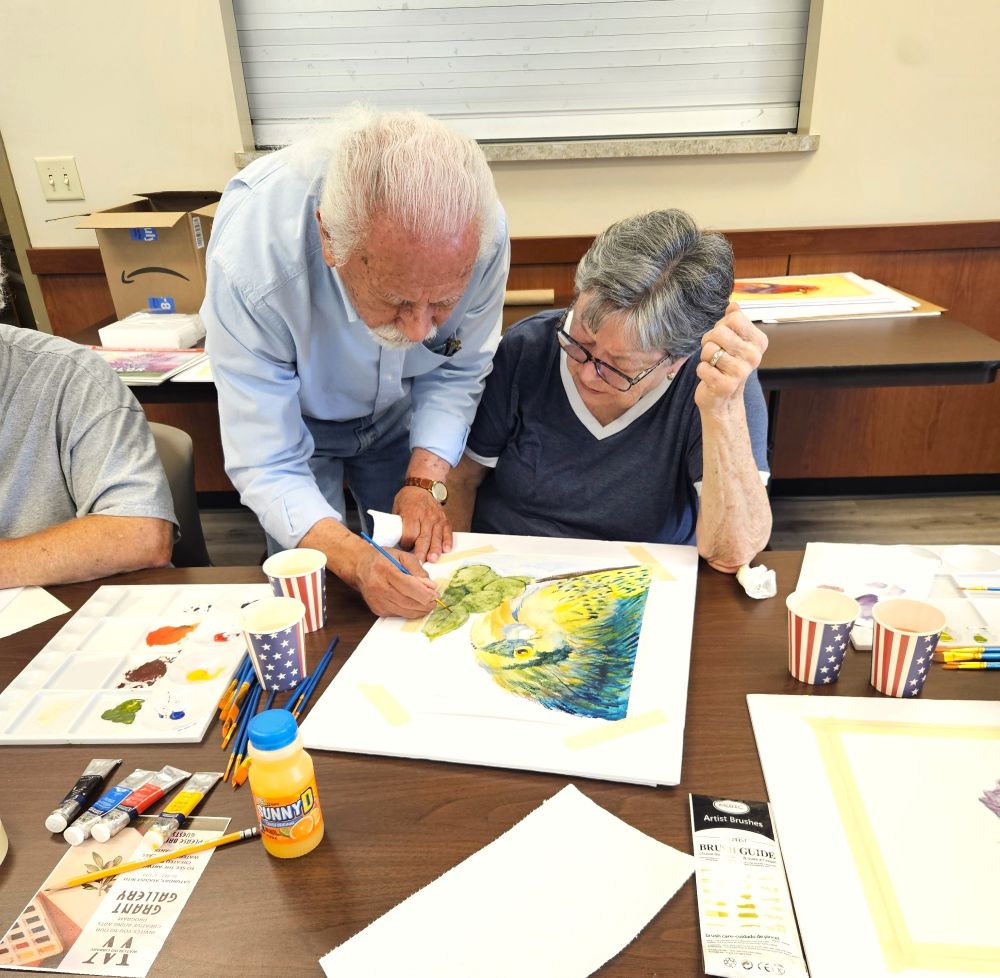
Visual arts program at Waterloo Public Library in Waterloo, NE.
What is Creative Aging?
Creative aging is the practice of intentional artistic and creative engagement throughout our lives to support our health, connection, and purpose as we age. It recognizes that creativity is lifelong—and that older adults are essential cultural contributors across all art forms, skill levels, and communities (Lifetime Arts, 2025).
“Music in the soul can be heard by the universe.” Lao Tzu
Population, Policy, and Issue Context for Creative Aging
Multiple system-level factors may facilitate the widespread adoption of creative aging into the healthy aging ecosystem. These include current patterns of population aging, key service and policy drivers at the federal and state levels, and the intersection with three trending issues in healthy aging: brain health, social connectedness, and livable communities.
AGING IN AMERICA
Once considered a distant demographic anomaly, the rapid growth of America’s older adult population is now in full bloom. One-sixth of the US population is age 65 and older, reaching almost 58 million in 2022 representing a 34% increase over the last ten years (compared to a 2% increase for those under age 65). By 2030, Americans in the Baby Boomer generation (born between 1946-1964) will be at least 65 years old (ACL, 2024).
While aging Baby Boomers garner much media coverage, the reality is that today’s older adults are the most diverse in America’s history. Far from a generalized group, older adults range from age 65 to almost 115 years old, have a wide range of backgrounds, needs, desires, and preferences, and are regularly dismantling stereotypes about what it means to be “old.”
17.5 million will be 85+ by 2060, representing almost 5% of the total population.
29% of older women are widowed—three times higher than older men.
24% rated their health as fair or poor.
28% of those in the community live alone.
1/2 of older adults live in nine states.
70% of older adults today will need some daily care support in their lifetime.
22% provided care to a loved one or friend with daily needs in the past year.
Key Service and Policy Landscape
Most older adults in the US live in community outside of institutions, are involved with loved ones and their neighborhoods, and deal with intermittent health and daily living needs. However, the likelihood of health decline and injuries increases with age and can spark enduring challenges that compromise independence. To help older adults to live well and safely at home, five categories of services exist with broad examples below (Alkema, et al., 2003).
•Institutional Care: Medical diagnostic and treatment providers, hospitals, nursing facilities, home health care, and hospice. • Personal Care: Home care, assisted living, adult day care, and rehabilitative therapies. • Safety and Support: Adult protective services, care management, emergency response systems, and mental/behavioral health treatment. • Health and Wellness: Community and senior centers, information and assistance lines, meal preparation and delivery, and spiritual care. • Lifestyle: Age 55+ independent living communities, lifelong learning, legal services, and transportation.
These types of services are often regulated and occasionally funded by federal and state policies, with great variation among urban and rural landscapes. Three main policy pathways that regulate and fund aging-related services are Medicare & Medicaid, the Older Americans Act (OAA), and the state Multisector/Master Plans for Aging movement.*
1. Medicare&Medicaid: Signed into law in 1965, these policies direct federal and state action as well as funds to meet medically focused health needs and some daily living supports for older adults and people with disabilities. Medicare primarily funds Institutional Care services through federal dollars, where Medicaid generally covers Institutional Care, Personal Care, and Safety and Support through federal and state dollars. States have primary regulatory authority over health maintenance organizations (HMOs), which provide managed care insurance coverage for Medicare and Medicaid beneficiaries.
2. Older Americans Act(OAA): Also established in 1965, this federal law is a major funding vehicle for locally centered social, nutritional, and wellness programs that help Americans age 60 and above live in community and support family caregivers. States describe how funds will be spent by submitting a multi-year Older Americans Act (OAA) for federal approval—mostly targeting services in the Health and Wellness as well as Lifestyle categories.
3. State Multisector/Master Plan for Aging Movement (MPA): Beyond federal action, many governors realize that aging issues affect various state departments, agencies, and authorities. As such, several are developing Multisector / Master Plans for Aging: a state-specific policy blueprint to improve local and regional coordination efforts serving current and future older residents over the next 10 years (CHCS, 2026). Master Plans for Aging (MPAs) seek to align state-led policies and bolster private-sector partnerships that impact all five service categories.
*Several legislative and executive branch actions in 2025, including the Make America Healthy Again platform and the One Big Beautiful Bill, are changing some operations and funding for Medicare, Medicaid, and the Older Americans Act—all of which may affect state Multisector / Master Plan for Aging action. The depth and breadth of these impacts remains to be determined (KFF, 2025, US DHHS, 2025).
Trending Issues in Healthy Aging
As the number of older adults continues to grow and diversify while government leaders redesign the aging policy environment, three trending issues are currently shaping the healthy aging agenda. These are brain health, social connectedness, and livable communities. Within each trending issue and at their collective nexus, creative aging brings meaningful and unique offerings to the pursuit of holistic solutions.
Brain Health Public dialogue on age-related memory loss is far from new. However, extensive research now links brain functioning with physical, mental, and social attributes that can be managed and modified for healthy aging (AAN, 2025; NIA, 2025; Baker et al., 2025). Brain health—attaining and maintaining optimal brain function to best support well-being—can be improved through lifestyle behaviors like healthy nutrition, physical activity, and staying socially and intellectually engaged.
Creative aging has much to contribute to brain health, as arts learning and expression stimulate the brain’s multiple sensory pathways and encourage healthy behaviors like physical activity and intellectual engagement critical for success.
Social Connectedness The value of social networks and connections has renewed visibility given global stressors like the COVID pandemic and mass dependence on technology. About one in four older adults report being socially isolated, deteriorating both brain and body health (Donovan & Blazer, 2020). Research shows that older adults who actively build social connections have greater cognitive abilities, recover faster from injuries, have healthier eating and sleeping habits, and stronger immune systems (NASEM, 2020).
Creative aging is designed to enhance an older adult’s experience in arts learning, music appreciation, cultural events and the like. Intentional arts-based programming can help reduce social isolation in older adults and forge a pathway to build individual and community connections based on mutual interests.
Livable Communities Community and neighborhood factors also play an important role in the everyday well-being and mobility of older adults. AARP defined eight domains of livability that shape community health including social participation, respect and social inclusion, and outdoor spaces (AARP, 2016).
Livable communities that incorporate creative aging usually attract and retain engaged residents who in turn increase neighborhood involvement, promote tax base stability, and facilitate human and financial investment incentives.
Policy Recommendations
“A song is not a song until you sing it.” Oscar Hammerstein
The older adult population of today and tomorrow, along with the policy and service landscape that supports it, is approaching a new frontier that will impact the healthy aging policy agenda in a variety of ways. Creative aging has an essential role to maximize the visibility, values, and successes of arts, music, and culture-making efforts that complement healthy aging goals for individuals, communities, and the larger society.
Below are three policy recommendations with objectives geared to amplify and incorporate creative aging in the healthy aging ecosystem so that it is a shaping force for public consciousness, multisector policy decisions, and community-level action.
RECOMMENDATION #1: Elevate Awareness of Creative Aging
Elevate awareness of creative aging and its significant linkage to healthy aging among cross-sector local, state, and federal leaders with emphasis on trending issues of brain health, social connectedness, and livable communities.
Objective 1A: Develop, test, and launch a multimodal, multi-stakeholder communications campaign that dissolves barrier mindsets and amplifies positioning of creative aging in healthy aging’s three trending issues.
Objective 1B: Develop model survey/polling language on creative aging with core components of healthy aging’s three trending issues and embed in national, state, and private sector population datasets and polling.
RECOMMENDATION #2: Embed Creative Aging Principles into Policy
Embed creative aging principles and attributes in federal and state policy plans and implementation efforts that are centered on healthy aging with specific ties to brain health, social connectedness, and livable communities.
Objective 2A: Develop and disseminate model language on creative aging for states to incorporate into Multisector / Master Plans for Aging and implementation initiatives, Older Americans Act (OAA) State Plans on Aging, Medicaid waiver programs, and Medicare and Medicaid HMO regulations.
Objective 2B: Develop and disseminate core concepts of creative aging for the federal Department of Health and Human Services to incorporate into healthy aging-related plans and implementation initiatives.
RECOMMENDATION #3: Accelerate Investment in Creative Aging
Accelerate diffusion of and investment in creative aging efforts within health-and aging-focused service landscapes, particularly in the private sector, which seek improvements in brain health, social connectedness, and livable communities.
Objective 3A: Collaborate with health-and-aging-focused service providers to initiate scale and spread of current and emerging creative aging efforts with emphasis on healthy aging’s three trending issues.
Objective 3B: Partner with community foundations and donor-advised fund administrators to design and embed creative aging into healthy aging initiatives and cyclical funding processes with emphasis on the three trending issues.
“He who works with his hands and his head and his heart is an artist.” St. Francis of Assisi
These recommendations are further developed in our upcoming Action Plan Framework that will describe potential strategies and tactics, critical partnerships, implementation considerations, and ways to measure success over a three-year period.
The Action Plan Framework is a starting point for realizing the promise of creative aging to reshape the cultural narrative on older adulthood toward one of vibrant living through the arts across all ages and life stages.
Gretchen Alkema, Ph.D. is president of Wolf Eagle Enterprises, LLC—a strategic engagement firm that delivers clear-eyed insights and resource-conscious solutions to health, aging, and care delivery industries.
Acknowledgements
This report was generously supported by The Music Man Foundation. We wholeheartedly thank our Policy Advisory Working Group who provided valuable perspective and feedback throughout the development of this brief.
AARP & National Alliance for Caregiving (NAC). (2025). Caregiving in the US 2025. Washington, DC: AARP. Accessed at https://doi.org/10.26419/ppi.00373.001.
Baker, L. D., Espeland, M. A., Whitmer, R. A., et al. (2025). Structured vs Self-Guided Multidomain Lifestyle Interventions for Global Cognitive Function: The US POINTER Randomized Clinical Trial. Journal of American Medical Association. Accessed at doi:10.1001/jama.2025.12923.
Bone, J. K., Bu, F., Sonke, J. K. et al. (2024). Leisure engagement in older age is related to objective and subjective experiences of aging. Nature Communications, 15. Accessed at https://doi.org/10.1038/s41467-024-45877-w.
Bone, J. K., Bu, F., Sonke, J. K., et al. (2023). Longitudinal associations between arts engagement and flourishing in young adults: A fixed effects analysis of the Panel Study of Income Dynamics. Affective Science, 4, 131–142. Accessed at https://doi.org/10.1007/s42761-022-00133-6.
Bone, J. K., Bu, F., Fluharty, M. E., et al. (2022). Engagement in leisure activities and depression in older adults in the United States: Longitudinal evidence from the Health and Retirement Study. Social Science & Medicine, 294. Accessed at https://doi.org/10.1016/j.socscimed.2022.114703.
Chorna, O., Filippa, M., Sa De Almeida, J., et al. (2019). Neuroprocessing Mechanisms of Music during Fetal and Neonatal Development: A Role in Neuroplasticity and Neurodevelopment.Neural Plasticity. Accessed at https://doi.org/10.1155/2019/3972918.
Cohen, G. D., Perstein, S., Chapline, J., et al. (2006). The impact of professionally conducted cultural programs on the physical health, mental health, and social functioning of older adults. The Gerontologist, 46(6), 726-34. doi: 10.1093/geront/46.6.726.
Donovan, N. J. & Blazer, D. (2020). Social isolation and loneliness in older adults: Review and commentary of a National Academies Report. American Journal of Geriatric Psychiatry, 28(12):1233-1244. doi: 10.1016/j.jagp.2020.08.005.
Fancourt, D., & Finn, S. (2019). What is the evidence on the role of the arts in improving health and well-being? A scoping review. World Health Organization Regional Office for Europe. Accessed at https://www.ncbi.nlm.nih.gov/books/NBK553779/.
Fioranelli, M., Roccia, M. G., & Garo, M. L. (2023). The role of arts engagement in reducing cognitive decline and improving quality of life in healthy older people: a systematic review. Frontiers in Psychology, 14, https://doi.org/10.3389/fpsyg.2023.1232357.
Fluharty, M., Bone, J., Bu, F., Sonke, J., et al. (2021). Associations between extracurricular arts activities, school-based arts engagement, and subsequent externalising behaviours: Findings from the Early Childhood Longitudinal Study – UCL Discovery. Accessed at https://doi.org/10.31234/osf.io/gdk3t/.
Galassi, F., Merizzi, A., D’Amen, B., & Santini S. (2022). Creativity and art therapies to promote healthy aging: A scoping review. Frontiers in Psychology, 13, https://doi.org/10.3389/fpsyg.2022.906191.
Kaimal, G., Ray, K., & Muniz, J. (2016). Reduction of cortisol levels and participants’ responses following art making. Art Therapy, 33(2), 74–80. Accessed at https://doi.org/10.1080/07421656.2016.1166832.
National Academies of Sciences, Engineering, and Medicine (NASEM). (2020). Social Isolation and Loneliness in Older Adults: Opportunities for the Health Care System. The National Academies Press; Washington, D.C. Accessed at https://pubmed.ncbi.nlm.nih.gov/32510896/.
Sonke, J., Manhas, N., Belden, C., et al. (2023). Social prescribing outcomes: a mapping review of the evidence from 13 countries to identify key common outcomes. Frontiers in Medicine, 10:1266429. https://doi.org/10.3389/fmed.2023.1266429.
Stickley, T., Wright, N., & Slade, M. (2018). The art of recovery: outcomes from participatory arts activities for people using mental health services. Journal of Mental Health, 27(4), 367–373. https://doi.org/10.1080/09638237.2018.1437609
Strong, J. V., & Mast, B. T. (2018). The cognitive functioning of older adult instrumental musicians and non-musicians. Aging, Neuropsychology, and Cognition, 26(3), 367–386. https://doi.org/10.1080/13825585.2018.1448356
Alkema, G. E. (2026). Creative Aging in the Healthy Aging Ecosystem: Advancing Brain Health, Social Connectedness, and Livable Communities. CreativeHealthyAging.org.